From Job-Centric to Self-Centric
During a period of career uncertainty, I read several books and listened to a few talks. One was Dan Koe’s Purpose & Profit. Reading it felt like a sudden, heavy blow—as if I had been pushed into a dark abyss. However, the author clearly wasn’t trying to discourage readers; rather, he was urging them to face problems courageously in order to solve them. He outlined the inherent limitations of industrial workers and the dark reality of AI replacing human labor, while handing us a torch called “the creator.” Following that light, Yang Shu’s Reboot: AI Career Transition offered actionable advice, while Pieter Levels’ sharing on building a one-person business revealed a distinct, unconventional path.
1. The Pain of Industrial Workers
Reflecting on my own experiences, I realized the primary difference between entrepreneurs and traditional corporate employees: Entrepreneurs act proactively. They tackle complex situations and resolve problems using multidimensional skills, focusing on “doing the right things.” In contrast, corporate employees mostly act reactively, working on clearly assigned tasks with a single skill set and focusing on “doing things right.”
Take Pieter Levels, a solopreneur, as an example: When developing a product, his main concern is satisfying customer needs once the requirements are met; he cares little about how complex the underlying technical architecture is. For a corporate programmer facing similar requirements, the process is entirely different. First comes a complete project initiation, followed by a lengthy R&D process, and finally, system analysis and coding using the company’s designated tech stack. Once the task is finished, it’s best if the solution carries a degree of complexity and technical highlights so there is something impressive to present during performance reviews. Whether the end customer is truly satisfied, or how the product and business operate and optimize, becomes secondary. Pieter Levels learns technology based on real-world needs, recommending direct answers via Google search rather than systematically attending training courses. In his eyes, technology is always a means, never the end. However, formally trained employees often expend most of their energy on technical details, inadvertently turning technology into the end goal itself.
Taking myself as an example: During my time as an employee, I often fell into a vicious cycle—wanting to rest after working briefly, yet constantly thinking about work while resting, with everything centered around my job. After spending over a decade in front-end development within factory-like environments, the logical choice seemed to be searching for a similar role at another company. Yet during interviews and technical tests, I genuinely felt the pain of grinding LeetCode problems, the discomfort of being evaluated like a replaceable machine part, and the internal conflict of trading even more time and freedom just for survival.
Later, I attempted to transition toward freelance full-stack development. Although I engaged with modern community tech stacks and experienced how efficient open-source solutions can be away from closed corporate processes—often enabling similar tasks to be completed faster and better—a new sense of confusion arose as freelance competition intensified and AI tools proliferated. After mastering the tech stack and using AI to boost efficiency, I realized I had merely become an “enhanced part”—more efficient and comprehensive, but still just a part in a system.
Of course, observing these differences is merely looking at the surface; I needed to dig into the underlying causes to gain deeper insights.
In his book, Dan Koe candidly points out that many modern professions and jobs originated from the division of labor during the Industrial Era. While this model boosted productivity and provided basic survival security for individuals, its monotonous and repetitive nature inevitably hindered personal growth and proactivity, bringing long-term negative consequences. Combining this insight with my past experiences, it hit the nail right on the head. If the goal of education and training has been to produce obedient, consistent “industrial workers” with specialized skills, then every phenomenon in the corporate workplace suddenly makes sense.
However, a serious problem arises: In the AI era, skill-based jobs with fixed routines are highly vulnerable to machine automation. Yet, precisely because these individuals have spent long periods in assembly-line environments, they often lack a broader understanding of life and the world, making it difficult to develop genuine problem-discovery and problem-solving abilities. Consequently, they find themselves at a disadvantage for survival and development amid technological shifts.
2. A Better Path for Life and Career Development
Previously, I had read biographies and writings by technology pioneers—including Steve Wozniak, Steve Jobs, Linus Torvalds (the creator of Linux), and Chen Hao’s (known online as “LeftEarMouse”) column Listening to the Wind.
Looking back at Wozniak’s childhood, he grew up in Silicon Valley during the golden era of computing history. Kids in the neighborhood enjoyed tinkering with electronic components. The knowledge and capability built through learning while playing were worlds apart from doing exam problems in a classroom. Even if the subject knowledge overlapped, the underlying curiosity, hands-on ability, and problem-solving mindset were entirely different. Even the famous Apple II was never created to meet sales targets or KPIs; it was simply something he personally wanted to build and worked hard to bring to life.
Consider Steve Jobs: He possessed a paranoid and idiosyncratic personality, went through the ordeal of being ousted from the company he founded, and faced life-and-death moments with cancer. Naturally, his perspective on life and the world was far deeper than average. Linus Torvalds created Linux simply “for fun,” and many of his subsequent technical explorations were driven by a search for meaning or pure enjoyment. Meanwhile, Chen Hao demonstrated a remarkably pure faith in technology and a deep understanding of core competitiveness in Listening to the Wind. Clearly, none of them were assembly-line industrial workers, nor could they ever be mass-produced by an industrial worker mindset.
How did they create such brilliant products and careers? The answer lies hidden in their biographies and written memories: They were not “cultivated” by a system; they grew naturally through life. Steady, natural growth equipped them with capabilities and mindsets completely different from those of industrial workers, while bestowing upon them irreplaceable uniqueness, taste, and insights in the AI era.
In an era where AI seems omnipotent, they highlight the unique value of human beings: Humans derive their uniqueness from “existence” and “living.” This existence-based uniqueness is something AI cannot comprehend or simulate. To survive, humans must engage with the real world; upon that foundation, they develop hobbies, cultivate capabilities through those hobbies, and build products, services, and value based on those capabilities. Similarly, driven by interests and skills, they connect with like-minded people to form niche communities.
Therefore, to live a better life, one must first break away from the outdated “job-centric” mindset, return to oneself, stay open and curious, and refrain from abandoning seemingly “useless” hobbies or viewing things through a single dimension. Only through continuous daily iterations of reading, listening, writing, and thinking can one truly become oneself. Capabilities emerge from interests, and products or services are built from capabilities. Conversely, without personal growth and genuine experiences of life, it is impossible to gain deep insights from a monotonous work life, let alone develop problem-finding, problem-solving, and multidimensional thinking abilities.
Thus, even if the goal is to earn more money or secure a better career, one cannot achieve it by blindly working hard and sacrificing personal growth. Instead, one must first “slow down,” take care of physical health, and listen to inner interests. Only by taking deep root in life and in oneself like a tree can one become irreplaceable and continue to grow.
This state of “becoming oneself and tapping into unique power” reminds me of Naruto from the anime Naruto. Early on, Naruto possessed average abilities, but once the Nine-Tails seal within him was released, immense power surged forth. The concept of “an inner reservoir of power waiting to be unsealed” is a compelling psychological metaphor: Everyone carries their own “Nine-Tails” inside, waiting to be discovered and unleashed.
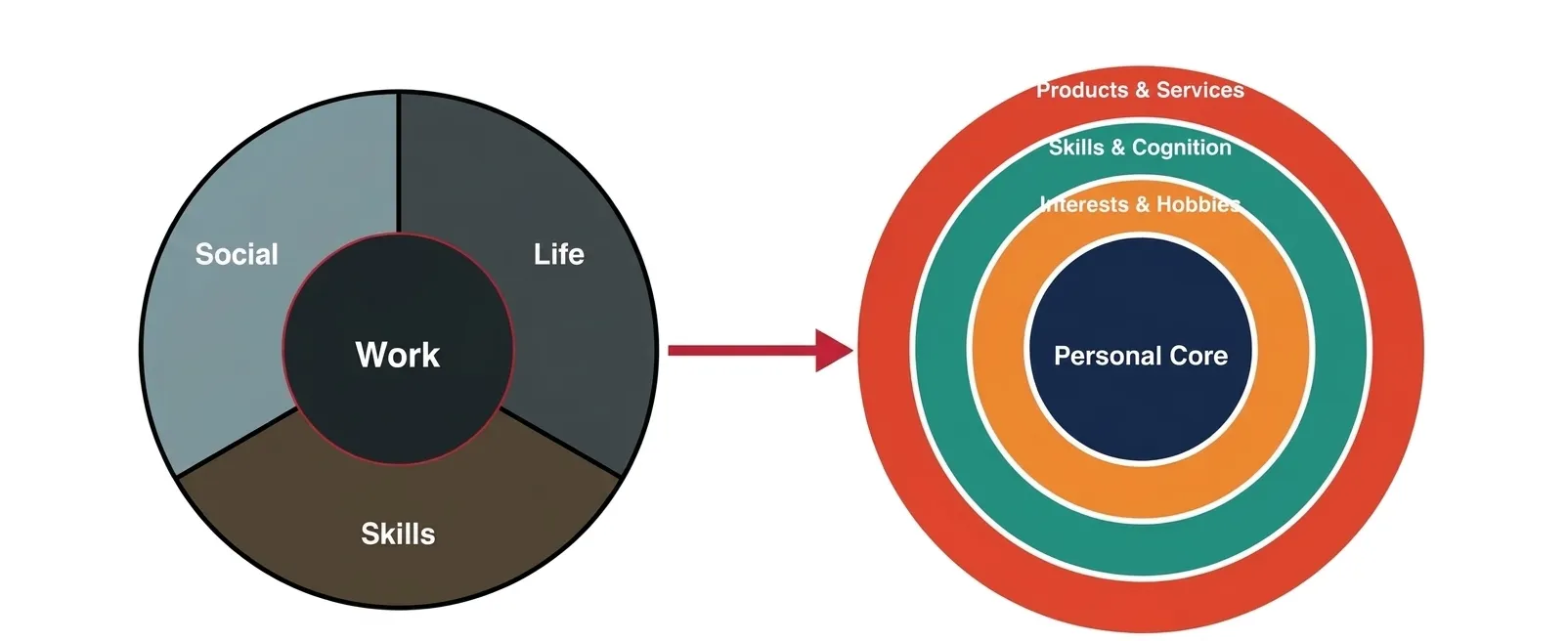
3. Concrete Actionable Steps
A while ago, when I pushed my full-stack development and self-media explorations to a certain stage, I experienced a period of confusion. Looking back, the core issue was that I placed too much emphasis on external “skills” while neglecting that “myself” is the true core engine.
For me, the most effective next steps are likely:
1. Listen to Yourself and Nurture Yourself
Start working out daily and prioritize physical health. Encourage yourself to explore different domains, building a broader knowledge base and wider interests. Avoid reflexively resisting new things; practice self-compassion and reduce overly utilitarian motives. Understanding the world helps build a broader worldview; understanding yourself helps shape your outlook on life and values. These form the sturdiest foundation for future living and working.
2. A Better Approach to Using Self-Media
Self-media is a standard tool of this era, but it must be understood and approached correctly. Organize your thoughts according to the characteristics of different platforms, focusing on expressing content that aligns with yourself and the media medium, rather than blindly chasing trends or hot topics. The key is to consistently output the voice you genuinely want to express. When consuming content daily, step outside the passive consumer mindset and pure entertainment seeking; instead, study how excellent creators select topics and design “hooks,” drawing insight and experience from the broader world.
3. Build Capabilities from Hobbies, and Construct Products & Services from Capabilities
Continue accumulating skills and practical experience, but only on the condition of maintaining interest and focus, rather than sacrificing enthusiasm for short-sighted utilitarian gains. Completely abandon corporate habits focused on technical complexity or “using technology as an end in itself.” Focus on simple, useful outcomes: Learn whatever is missing, apply it immediately, and dive deeper when interested or needed. Build engineering capabilities based on “simplicity and practical utility,” along with the complete capability system of problem-finding, problem-solving, and value judgment behind them.
4. Learning and Practicing the “Solopreneur” Business Model
Continuously explore and look for mini-business models that align with your unique traits. A line from Yang Shu’s book left a deep impression on me: Using AI to empower development only yields a “multiplicative” increase—essentially competing with peers in efficiency and speed to earn income through intense competition. The true, far greater value of AI lies in “exponential” growth—creating entirely new businesses and value.
In short, the ultimate goal is not to trade more time for more money, nor to swap suffering for income, but to focus first on “becoming oneself.” After that, everything will gradually fall into place. Especially in an era dominated by AI, the taste and authentic experiences born from unique growth and real existence are truly irreplaceable.
No one can predict the future, but we can adapt to trends. In the process of discovering and facing the unknown, cultivating problem-solving abilities, acquiring specialized knowledge and skills, we will eventually transcend assembly-line “industrial workers” and become our unique selves.
4. References
- Purpose & Profit by Dan Koe
- How to Build a Startup Without Funding by Pieter Levels
- Reboot: AI Career Transition on WeChat Read by Yang Shu
- Listening to the Wind by Chen Hao (LeftEarMouse)
- Steve Jobs by Walter Isaacson
- iWoz by Steve Wozniak
- Just for Fun: The Story of an Accidental Revolutionary by Linus Torvalds