Re-reading Hackers: Heroes of the Computer Revolution
Hackers: Heroes of the Computer Revolution is the most deeply impressive and admirable book I have read in recent years. Its brilliance lies in its restraint from excessive subjective summarizing; instead, through rich interviews and historical materials, it faithfully recreates the people and events of that era. Like a tour guide, it invites readers to look through its lens and experience the hacker culture and the evolution of the computer. It leaves space for everyone to feel, reflect, and discover their own answers to what a computer truly is and what constitutes the hacker spirit.
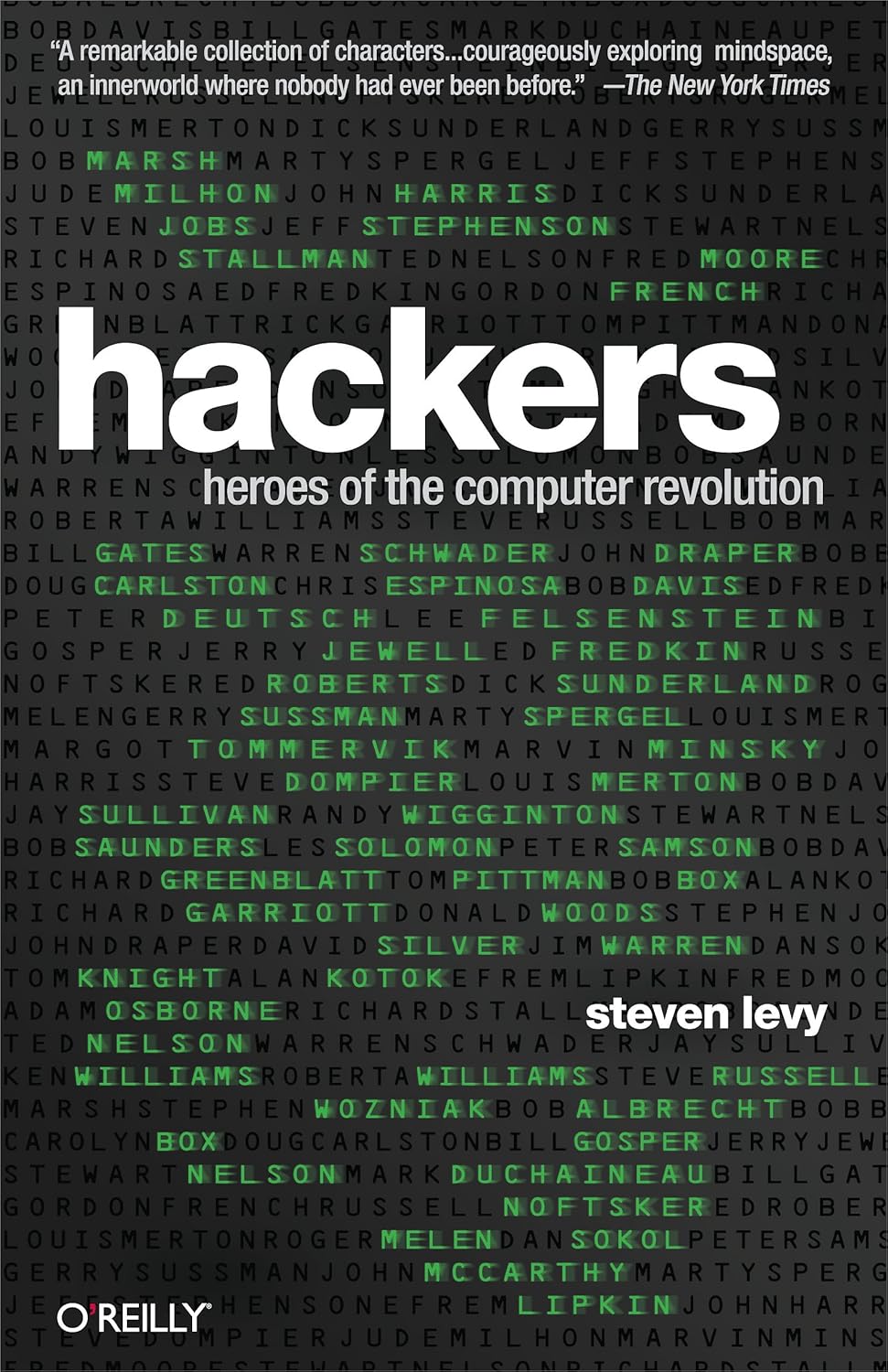
Recently, after reading it on and off, I finally finished the book, leaving my mind racing with thoughts. I know it is difficult to fully comprehend or articulate all of this, but as my life experience grows, I feel compelled to try and answer certain questions about life and the choices we make.
I. Two Different Kinds of People
Among my relatives in my hometown, most of the older generation pursued a peaceful, stable, and ordinary life. When they passed away, they came and went quietly, leaving almost no trace behind. But two of them are still frequently mentioned by their peers, their stories continually passed down.
One was my grandfather. I heard that in his youth, he loved reading so much he would often stay up until one or two in the morning. He had exceptional mechanical engineering skills—he could diagnose a car engine’s problem just by listening to the sound it made. Whether it was water, electricity, gas, or machinery, he could figure it out just by tinkering with it. He eventually became a regional expert in agricultural machinery and was even sent abroad for work at the age of 60. Unfortunately, he later passed away from severe asthma.
The other was my father. In an era when merely getting enough to eat and wear was a struggle, he played the violin beautifully and wrote elegant calligraphy. As my uncle put it, my father had spiritual pursuits that transcended everyday life. During the harsh years as a “sent-down youth” in the countryside, many people loved listening to him play his violin. He had a sharp, agile mind and strong hands-on skills; no matter how poor the conditions were, he could raise sheep and fish to improve the family’s life. Had he not been a victim of his times, he might have become an outstanding entrepreneur. Everyone knows his trajectory later in life: he was laid off, failed at running businesses out of town, returned home to open a restaurant with no success, and ruined his health staying up late to run a small guesthouse. After falling ill and losing full mobility in his limbs, he could only make a living by working as a gatekeeper, passing the time by playing chess online. Later still, after his children’s careers had stabilized and their weddings were taken care of, he fell seriously ill during the pandemic. In the end, out of a fear of being a burden, he didn’t even call his family to see him one last time.
My earliest memories of my father were filled with resentment, envying the affluent lives of my peers. Today, that has mostly turned into admiration and marvel, and I have finally come to understand the helplessness and powerlessness of that era—no matter how much effort and change an individual attempted, it was ultimately difficult to break through the layered nets of environmental and physical constraints.
II. A Guided Life
As a child, I was introverted, spoke little, and loved to think and tinker—whether it was messing around with various materials, playing with bugs, or raising small animals. As I got older, I would hunt for books at second-hand stalls, studying everything from occult talismans to science magazines. Then I caught the wave of computers and the internet. It seems starting in elementary school, we had microcomputers and computer labs. I first encountered computers around then at the Children’s Palace, learning LOGO and turtle graphics. In middle school, there were extracurriculars and lab classes—though the computer rooms were heavily guarded, requiring us to turn on the power supply before the monitor, and only introduced basic hardware and typing, saving things on floppy disks. In high school, many people used Wenquxing electronic dictionaries, which had BASIC programming, to play games. Even though computers had entered our studies and lives, our overall focus during elementary and middle school was on grades and exams; almost no kids around me developed a sustained drive to explore computers deeply.
Upon entering university, it was impossible to have much interaction in a lecture hall of a hundred people. The courses started right away with computer architecture and functions, followed by how to write programs. It felt just like high school—just another form of exam-oriented education where we memorized concepts and rules for a different set of subjects. I deeply resisted this system. I desperately wanted to find answers to “why is it done this way, why was it designed like this?” I wanted to know not just the technical design, but also the designers and the context of their era. Naturally, textbooks that solely focused on technology couldn’t satisfy me, so I frequently wandered the art bookshelves seeking spiritual escape.
Towards the end of high school and during university, we were introduced to career planning. Counselors used the popular MBTI personality test to help us choose our majors, but no matter how we tested, the results felt ineffective and vague. Looking back now, the real reason wasn’t that the tools were inaccurate; it was that after a dozen years of schooling, we had barely interacted with the world and society. We hadn’t formed our own worldview, outlook on life, or values, so naturally, we lacked our own judgment when it came to making choices.
Did I find my direction and judgment once I started working? It was still difficult. After starting work, the drive simply shifted from exam scores to KPI performance. In the workplace, you meet many seemingly technically brilliant people, but upon closer inspection, their actions feel highly utilitarian and dull. They primarily use their skills to prove they are exceptional “cogs in the machine” in order to secure job opportunities and wage premiums.
Those involved are blind; onlookers see clearly. Today, I can summarize this experience: middle and high school education is for selection, and university is for training industrial workers to serve the industrial needs of society. From a macroeconomic perspective, this is beyond reproach; it is sufficient to keep society running and keep people fed and clothed. But for an individual with personal pursuits and beliefs, it cannot carry the weight of, nor answer, the deeper questions of life.
III. Questions and Answers
Through the book, I traveled back in time to the history of hacker culture. The epicenter of the hacker movement went through several periods: the MIT AI Lab, the Homebrew Computer Club, and the era of software stars. The hackers who initially propelled computer development were launched like pinballs in an arcade game, falling into different slots and meeting different fates. However, I noticed they shared two consistent traits:
-
Their skills were not acquired through training, much less exams, but through curiosity, hands-on ability, and an inner drive to change the status quo and make things better—a capability formed through long-term learning and practice.
-
What remained consistent and ran through everything they did was their inner Hacker Ethic: curiosity, fun, and a bias toward action. This was the anchor of their lives and their ultimate destination.
In other words, they didn’t learn for grades or a job. The purpose of their work with computers wasn’t just to make a living; it was where their true interest, joy, and meaning lay.
It reminds me of Mufasa telling Simba to “Remember who you are” in The Lion King, Steve Jobs talking about “knowing yourself and following your heart” in his speeches, and Naval Ravikant saying “Be yourself, you are irreplaceable.” They echo each other across distances, sharing a single realization: you must “know yourself.” To put it plainly, a person must have their own worldview, outlook on life, and core values. This is the anchor of life; a life without an anchor is destined to drift with the current.
But how easy is it to establish these core anchors? Today, during our student years, good exam scores equal positive feedback; during our working years, good KPIs equal positive feedback. It seems that better grades and better KPIs represent better learning and professional ability. But in reality? I remember learning a lot about circuits in high school, yet having almost no ability to physically build or design anything based on that knowledge. In university, the few people with the highest exam scores didn’t actually have great computer skills, and at work, those with the best performance reviews weren’t necessarily the most technically outstanding. It is clear that many people today are guided by standards—even many seemingly “correct standards” are actually unreliable, making it difficult to accumulate the genuine perception and hands-on experience of the world necessary to form one’s own values. I had a period of frustration about this. Later, I realized that the past cannot be redone, nor can I participate in that free and vibrant hacker era. I think seeing the problem clearly is already a huge step forward. I might as well accept reality and step by step strive toward the right direction.
IV. Thoughts from the Journey
While my career was at a standstill, I took advantage of my child’s summer vacation and drove back to my hometown for two months. I glanced through many cities—the bustling, beautiful, and crowded Yunnan; Jiangyou with its stunning scenery; the prosperous and mature Chengdu… Along the journey, I observed the cities and their people. These past two months on the road have greatly expanded my experience and awareness.
I felt a sense of unfamiliarity and shock seeing cafes at the foot of snow-capped mountains full of young people, and so many people strolling through ancient towns, simply because it was a workday. For someone used to leaving early and returning late for the daily grind, this was unimaginable. It showed me that many people live without adhering to traditional work hours. Recently, AI Agents have become popular, ostensibly capable of replacing human roles in many scenarios. But based on what I saw and felt on my trip, generally speaking, I still prefer humans. They are more relatable and intimate than machines. Although humans bring more uncertainty, this actually adds resilience and possibility. While there is competition and friction, society as a whole is made up of people relying on each other, interdependent through mutual service. This might be the reason cities exist and the premise for many people and professions.
I’ve been thinking about whether I can still work in computer programming, but with a goal no longer tied to fulfilling KPIs or rushing schedules using mandated tech stacks. Instead, I want to pursue the inherent joy and value of the technology itself. I don’t want to set traditional professional boundaries—if I want to dabble in hardware tech, I will. I want to use hacker culture and the origins of computing as the cornerstone of my professional skills and interests. Ultimately, I also hope to integrate normally into life—no longer acting as an industrial worker purely focused on efficiency and output, but having my own hobbies outside of work, participating in circles I care about, and ultimately becoming a better version of myself with a solid foundation in real life.
V. What is Happiness
Finally, I think everyone’s ultimate pursuit involves three levels:
-
Having good, healthy physical well-being.
-
Establishing a connection and reliance with one’s environment, finding symbiosis.
-
Within one’s capacity and scope, choosing the life one wants and striving for it.
I don’t know what achievements from the younger generation bring the older generation the most comfort, nor what actions of the older generation command the most admiration from the young. My guess is that, while there will always be new hardships, overall, we have more choices than before. We have the opportunity to spend our lives the way we wish, to strive to provide new answers on established paths, and, in the end, to look back on the past without regret and without lingering attachments.